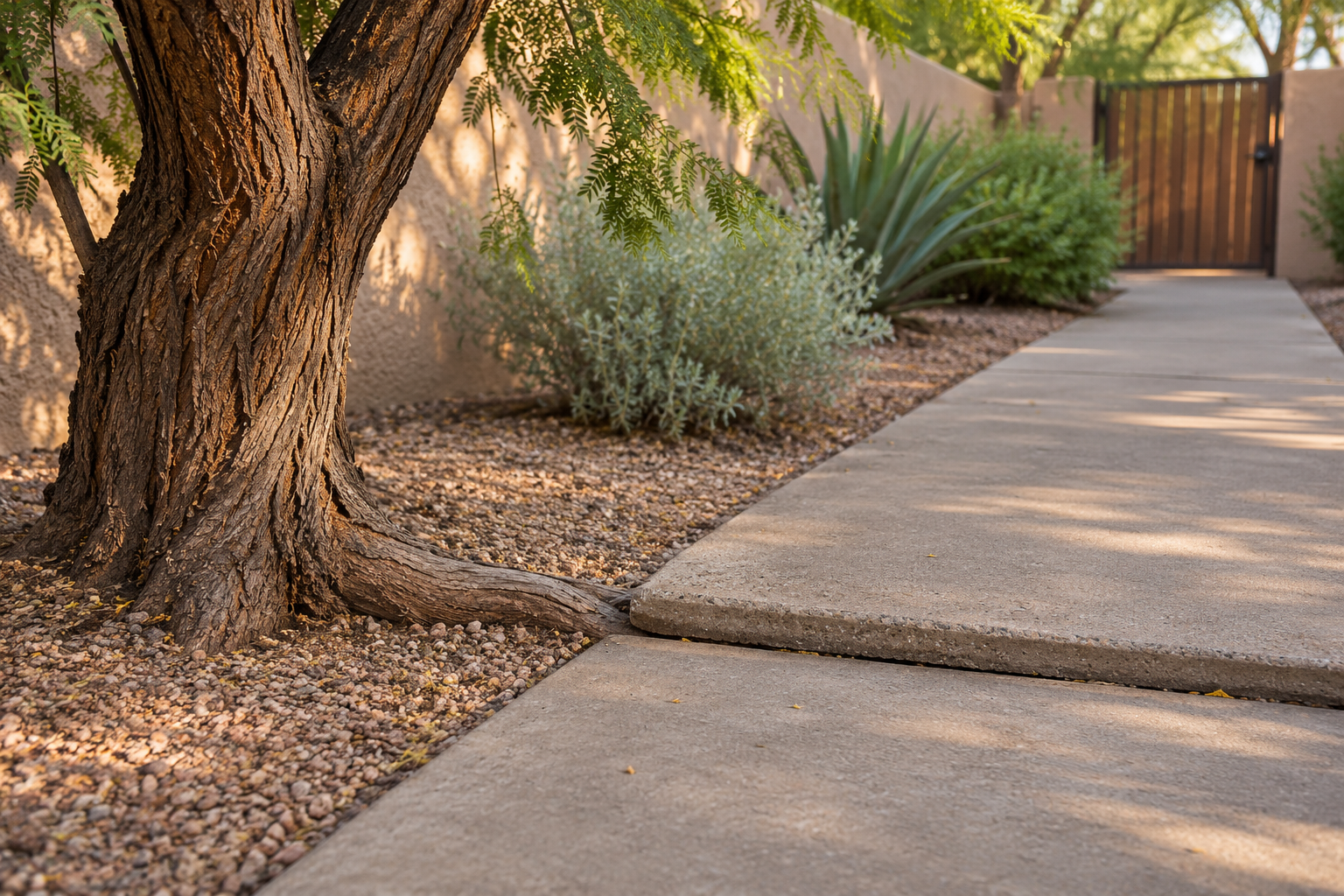
A raised joint beside a mature tree is worth assessing before repairs begin as seen in this rendering of a Tucson-style garden path.
B&C TREE SERVICE · TUCSON HOMEOWNER GUIDE
You notice it when you roll a trash bin toward the side gate. One wheel catches on a lip where two sections of concrete used to meet. A few feet away stands the tree that shades the west side of your house. You want the path level again. Do you have to give up the shade?
Often, you can repair a walkway and keep the tree. The best chance comes before demolition, while you can still change the path or the repair design. Start by finding out whether a root is actually involved, whether the walk is private or public, and which roots the proposed work would disturb. Until the uneven edge is addressed, use another route on your property where possible.
Is it your garden path or a Tucson public sidewalk?
A walkway from your patio to a side gate is a different project from the public sidewalk along your frontage. Within the City of Tucson, the owner of the adjoining property is responsible for maintaining the abutting public sidewalk, and a written city permit is required before repairing it. If the raised edge is on that sidewalk, contact the city before scheduling work. You can report the location through Tucson 311. If you have a repair notice, follow the instructions on it. City of Tucson sidewalk repair and permit guidance · Tucson 311
If you live outside Tucson city limits, check with the jurisdiction responsible for your street. For a private path, start with a different question: is there space to move the walk while keeping a comfortable, accessible route to the gate?
What should an arborist look at before anyone cuts a root?
A tree standing next to a raised slab is a clue. It takes an on-site look to establish what has moved and whether the proposed excavation would affect roots that help anchor the tree. A substantial root close to the trunk can matter to the stability of the whole tree. An assessment should account for the tree’s condition, where the cut would fall, and whether earlier work has already removed roots on another side. The Morton Arboretum’s guide to tree root problems
Bring two pictures to the conversation: a wide view showing the tree, path and gate together, and a low side view of the raised joint. Mention any trenching for irrigation or utilities you know about. Leave the digging to the people evaluating the site. What you need from the arborist is a specific answer: “Which roots would this repair affect, and what would you change about the plan to preserve them?”
Three repairs worth comparing for a private walkway
Move one section of the path. If there is open yard on the far side, a gentle bend around the tree may preserve both the root and a usable walkway. Ask the contractor to mark the proposed edges on the ground. Walk the route and check the width at the gate. Also ask where the crew would dig for the base. A new surface can clear the trunk while the excavation below it still reaches important roots.
Bridge the root. Where moving the path would send it into a wall or planting bed, ask whether a section can span the root with room beneath for growth. A workable design needs smooth approaches on both ends, stable support, and adequate drainage. Raising a single slab and leaving a new lip at the next joint simply moves the trip hazard.
Rebuild a short section with resettable pavers. Individual units can be lifted and reset if the surface moves again. Ask how much excavation the base needs and who will handle future adjustments. Pavers are worth considering when the base can be built without unacceptable root loss and you are comfortable with periodic maintenance. Iowa State University Extension on sidewalk repair options · University of Florida guidance on bridging and rerouting
When does tree removal enter the conversation?
Sometimes a house wall and a property line leave no room to move a path. If the only workable repair would sever roots the tree depends on for stability, ask the arborist to explain the consequences of retaining it. Existing decay, earlier root loss and what the tree could strike all matter. If removal is recommended, ask which finding drove that recommendation and which preservation option was considered. That gives you a basis for a decision or a second opinion. International Society of Arboriculture on managing tree risk
What should be in the estimate?
“Replace two sections of walkway” tells you what the finished job will look like. It leaves open what happens when the first slab comes up. Ask for the repair area, excavation limits, roots to be protected, and the person responsible for deciding what happens if the crew uncovers a substantial root. Agree on that pause point before demolition. If root cutting is proposed, ask for the arborist’s recommendation in writing.
Take the two estimates back out to the path. Can each contractor show you where the new edge will sit, how you will get through the gate, and how the tree will be protected during the work? Those answers are worth more than a price comparison between two vaguely similar bids.
B&C Tree Service is preparing for a planned March 2027 expansion into Tucson. This guide is part of our Tucson homeowner series.